Filter by
# Debug Box
/home/libk7946/public_html/hanysarono.info/lib/SearchEngine/DefaultEngine.php:610 "Search Engine Debug 🔎 🪲"
Engine Type ⚙️: "SLiMS\SearchEngine\DefaultEngine"
SQL ⚙️: array:2 [
  "count" => "select count(distinct b.biblio_id) from biblio as b left join mst_publisher as mp on b.publisher_id=mp.publisher_id left join mst_place as mpl on b.publish_place_id=mpl.place_id where b.opac_hide=0 and (b.biblio_id in(select bt.biblio_id from biblio_topic as bt left join mst_topic as mt on bt.topic_id=mt.topic_id where mt.topic like ?))"
  "query" => "select b.biblio_id, b.title, b.image, b.isbn_issn, b.publish_year, mp.publisher_name as `publisher`, mpl.place_name as `publish_place`, b.labels, b.input_date, b.edition, b.collation, b.series_title, b.call_number from biblio as b left join mst_publisher as mp on b.publisher_id=mp.publisher_id left join mst_place as mpl on b.publish_place_id=mpl.place_id where b.opac_hide=0 and (b.biblio_id in(select bt.biblio_id from biblio_topic as bt left join mst_topic as mt on bt.topic_id=mt.topic_id where mt.topic like ?)) order by b.last_update desc limit 10 offset 30"
]
Bind Value ⚒️: array:1 [
  0 => "%Dynamics%"
]
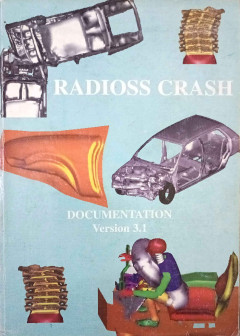
RADIOSS CRASH Documentation Version 3.1
This documentation manual provides comprehensive technical guidance for utilizing the RADIOSS CRASH software, which is a leading explicit finite element solver used for analyzing highly non-linear, transient dynamic events, most notably crashworthiness and impact simulations. It details the theoretical background of the solver, explains the input card structure, provides definitions for various…
- Edition
- -
- ISBN/ISSN
- -
- Collation
- 700 pages
- Series Title
- Engineering
- Call Number
- 1ENG100
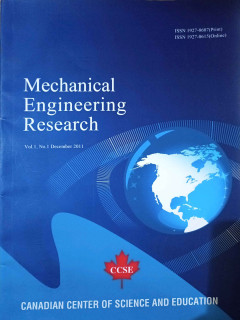
MECHANICAL ENGINEERING RESEARCH
The Mechanical Engineering Research (MER) journal, published by the Canadian Center of Science and Education (CCSE), is dedicated to advancing the theoretical and practical application of mechanical engineering science. It publishes high-quality original research articles, reviews, and technical notes covering all major areas of mechanical engineering. These areas typically include, but are not…
- Edition
- -
- ISBN/ISSN
- 1927-0607
- Collation
- 124 pages
- Series Title
- Engineering
- Call Number
- 1ENG99
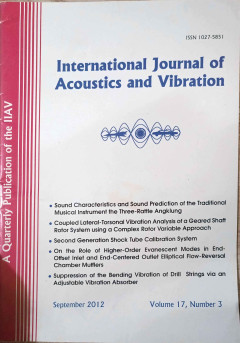
International Journal of Acoustics and Vibration
This journal publishes original research covering fundamental and applied topics in acoustics, noise, sound, vibration, and associated technologies. This specific issue (Volume 17, Number 3) contains articles on various subjects, including: Sound characteristics and prediction of the traditional musical instrument the Three-Rattle Angklung. Coupled lateral-torsional vibration analysis of …
- Edition
- -
- ISBN/ISSN
- 1027-5851
- Collation
- 168 pages
- Series Title
- Engineering
- Call Number
- 1ENG95
PAM-CRASH Implicit and Explicit Tutorial Manual
This tutorial manual provides practical, step-by-step instruction for using the PAM-CRASH software, focusing specifically on both implicit and explicit Finite Element Method (FEM) analysis techniques. It is designed to guide engineers and students through the creation, setup, and execution of complex structural dynamics problems, particularly those involving non-linear transient phenomena such …
- Edition
- -
- ISBN/ISSN
- -
- Collation
- 500 pages
- Series Title
- Engineering
- Call Number
- 1ENG95
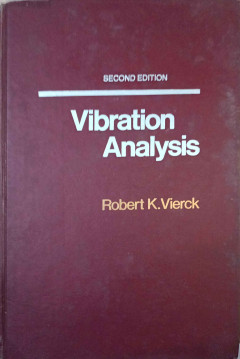
Vibration Analysis
This book, "Vibration Analysis," by Robert K. Vierck, serves as a classic textbook providing a thorough and accessible introduction to the theory and application of mechanical vibrations. It covers the fundamentals of single-degree-of-freedom systems, two-degree-of-freedom systems, and continuous systems. Key topics include free and forced vibration, damping, and the use of various mathematical…
- Edition
- 2nd Edition
- ISBN/ISSN
- 0-7002-2525-0
- Collation
- 811 pages
- Series Title
- Engineering
- Call Number
- 1ENG83
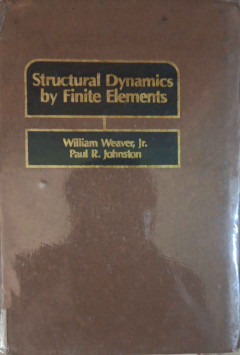
Structural Dynamics by Finite Elements
Presents a unified treatment of Structural Dynamics using the Finite Element Method (FEM). Intended as a foundational text in civil and engineering fields, it introduces the basic theory of structural dynamics and combines it with the principles of FEM for the analysis of complex structures. The content covers the formulation of mass and stiffness matrices for various structural elements, dynam…
- Edition
- 1st Edition
- ISBN/ISSN
- 0-13-853508-6
- Collation
- 591 pages
- Series Title
- Engineering
- Call Number
- 1ENG61
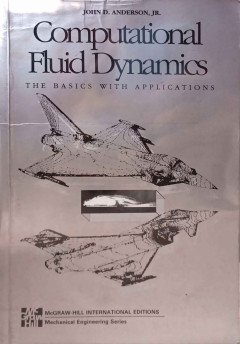
Computational Fluid Dynamics The Basics WIth Applications
omputational Fluid Dynamics: The Basics with Applications provides a foundational introduction to the principles, mathematics, and numerical methods underlying modern CFD. The book covers governing equations of fluid motion, finite difference and finite volume techniques, grid generation, numerical stability, convergence, and discretization strategies. Anderson explains key concepts such as pot…
- Edition
- -
- ISBN/ISSN
- 0-07-113210-4
- Collation
- 547
- Series Title
- Engineering
- Call Number
- 1ENG44
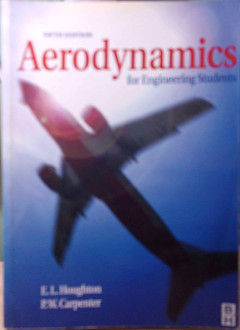
Aerodynamics for Engineering Students
Aerodynamics for Engineering Students provides a comprehensive introduction to the fundamental principles of aerodynamics for engineering applications. The book covers fluid-flow theory, airfoil and wing aerodynamics, boundary-layer behavior, lift and drag generation, and aircraft performance. It also examines compressible flow, shock waves, and high-speed aerodynamics, supported by clear mathe…
- Edition
- Fifth Edition
- ISBN/ISSN
- 0-7506-5111-3
- Collation
- 590
- Series Title
- Engineering
- Call Number
- 1ENG42
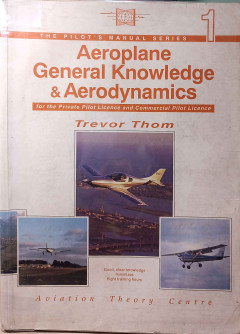
Aeroplane General Knowledge & Aerodynamics
Aeroplane General Knowledge & Aerodynamics provides a comprehensive introduction to the principles of aircraft systems and the fundamentals of aerodynamics for student pilots and aviation trainees. The book explains essential aircraft components, engine and electrical systems, flight instruments, and operational considerations. In its aerodynamics section, it covers airflow behavior, lift and d…
- Edition
- -
- ISBN/ISSN
- 1-875537-13-9
- Collation
- 250
- Series Title
- Aeroplane
- Call Number
- 1ENG40

Transonic Aerodynamics
Transonic Aerodynamics by Carlo Ferrari provides an in-depth examination of the physical principles and analytical methods used to study airflow in the transonic speed range—where both subsonic and supersonic regions coexist around an aerodynamic body. The book explains the formation of shock waves, nonlinear flow behavior, compressibility effects, and the challenges associated with predictin…
- Edition
- Second Edition
- ISBN/ISSN
- -
- Collation
- 651
- Series Title
- Enginering
- Call Number
- 1ENG35
 All Categories
  Engineering
  Social Sciences
  Computer Sciences
  Religion
  Arts and Recreation
  Natural Sciences