Filter by
# Debug Box
/home/libk7946/public_html/hanysarono.info/lib/SearchEngine/DefaultEngine.php:610 "Search Engine Debug 🔎 🪲"
Engine Type ⚙️: "SLiMS\SearchEngine\DefaultEngine"
SQL ⚙️: array:2 [
  "count" => "select count(distinct b.biblio_id) from biblio as b left join mst_publisher as mp on b.publisher_id=mp.publisher_id left join mst_place as mpl on b.publish_place_id=mpl.place_id where b.opac_hide=0 and (b.biblio_id in(select bt.biblio_id from biblio_topic as bt left join mst_topic as mt on bt.topic_id=mt.topic_id where mt.topic like ?))"
  "query" => "select b.biblio_id, b.title, b.image, b.isbn_issn, b.publish_year, mp.publisher_name as `publisher`, mpl.place_name as `publish_place`, b.labels, b.input_date, b.edition, b.collation, b.series_title, b.call_number from biblio as b left join mst_publisher as mp on b.publisher_id=mp.publisher_id left join mst_place as mpl on b.publish_place_id=mpl.place_id where b.opac_hide=0 and (b.biblio_id in(select bt.biblio_id from biblio_topic as bt left join mst_topic as mt on bt.topic_id=mt.topic_id where mt.topic like ?)) order by b.last_update desc limit 10 offset 0"
]
Bind Value ⚒️: array:1 [
  0 => "%Strength of Materials%"
]
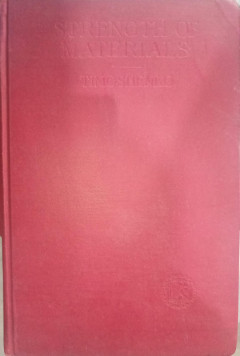
Strength Of Materials: Part I: Elementary Theory And Problems
This classic textbook provides a thorough introduction to the elementary theory of the strength of materials, focusing on the fundamental principles of mechanics as applied to engineering structures. The first part of this two-volume series covers basic topics such as tension, compression, shear, and the bending of beams. It is designed to bridge the gap between theoretical mechanics and practi…
- Edition
- 3rd Edition
- ISBN/ISSN
- -
- Collation
- 442 pages
- Series Title
- Engineering
- Call Number
- 1ENG220
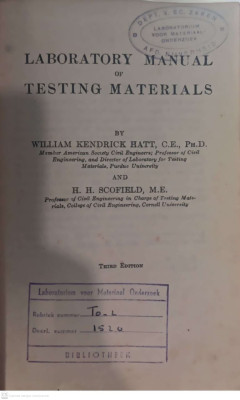
Laboratory Manual of Testing Materials
Laboratory Manual of Testing Materials is a foundational practical guide designed to assist engineering students in conducting physical tests on various building and construction materials. The manual provides step-by-step procedures for mechanical testing of essential materials such as cast iron, steel, cement, concrete, timber, and brick. It details methods for measuring key physical properti…
- Edition
- 3rd Edition
- ISBN/ISSN
- 978-0559200847
- Collation
- 182 pages
- Series Title
- Engineering
- Call Number
- 1ENG210
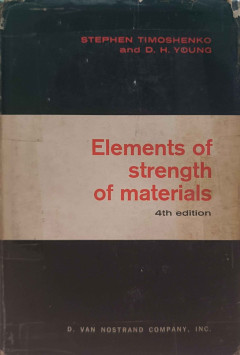
Elements of Strength of Materials
This classic textbook provides a comprehensive introduction to the mechanics of materials, focusing on the fundamental principles of stress and strain in deformable bodies. Specifically revised for undergraduate engineering students, this fourth edition incorporates updated problems and examples that bridge theoretical derivations with practical structural applications. Key topics include the a…
- Edition
- 4th Edition
- ISBN/ISSN
- -
- Collation
- 377 pages
- Series Title
- Engineering
- Call Number
- 1ENG157
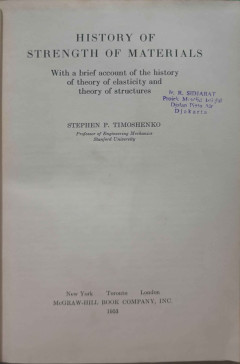
History of Strength of Materials
This seminal work provides a comprehensive historical account of the development of the science of strength of materials, from its early beginnings in the 17th century to the mid-20th century. Based on a series of lectures given by the author over twenty-five years, the book traces the evolution of structural engineering and mechanics, beginning with the pioneering work of Leonardo da Vinci and…
- Edition
- 1st Edition
- ISBN/ISSN
- -
- Collation
- 452 pages
- Series Title
- Engineering
- Call Number
- 1ENG155

Elements of Strength of Materials
This classic textbook provides a foundational introduction to the mechanics of deformable bodies, specifically tailored for undergraduate engineering students. In this third edition, the authors have expanded the material to include detailed discussions on the bending of beams in non-symmetrical planes and the bending of curved bars. The text establishes fundamental principles of stress and str…
- Edition
- 3rd Edition
- ISBN/ISSN
- -
- Collation
- 426 pages
- Series Title
- Engineering
- Call Number
- 1ENG153
Strength of Materials Part II: Advanced
This advanced volume by Stephen Timoshenko serves as a continuation of his foundational work on mechanics, delving into more complex problems of structural analysis and material behavior. Part II: Advanced covers specialized topics such as the deformation of curved bars, the theory of plates and shells, buckling of columns, and the analysis of stress concentrations. The text also explores the p…
- Edition
- 3rd Edition
- ISBN/ISSN
- -
- Collation
- 572 pages
- Series Title
- Engineering
- Call Number
- 1ENG150
Strength of Materials Part I: Elementary
This classic textbook by Stephen Timoshenko, often regarded as the "father of modern engineering mechanics," provides a fundamental introduction to the strength of materials. Part I: Elementary focuses on the basic principles required for structural analysis, including tension and compression, combined stresses, and the theory of bending in beams. The text is renowned for its pedagogical clarit…
- Edition
- 3rd Edition
- ISBN/ISSN
- -
- Collation
- 441 pages
- Series Title
- Engineering
- Call Number
- 1ENG149
Applied Mechanics
Applied Mechanics is a foundational engineering textbook translated from the original Russian edition, designed to provide students with a clear understanding of the mechanical principles governing engineering structures and machinery. The book is divided into several key sections, starting with the fundamentals of Statics, followed by the Kinematics and Dynamics of particles and rigid bodies. …
- Edition
- -
- ISBN/ISSN
- -
- Collation
- 368 pages
- Series Title
- Engineering
- Call Number
- 1ENG148
Theory of Elasticity
This classic and globally recognized textbook provides a comprehensive treatment of the theory of elasticity, serving as a fundamental resource for engineers and researchers in structural and mechanical sciences. The authors utilize mathematical rigor to develop the general equations of equilibrium and compatibility, focusing on the analysis of stress and strain in deformable bodies. Key topics…
- Edition
- 3rd Edition
- ISBN/ISSN
- 07-085805-5
- Collation
- 568 pages
- Series Title
- Engineering
- Call Number
- 1ENG147
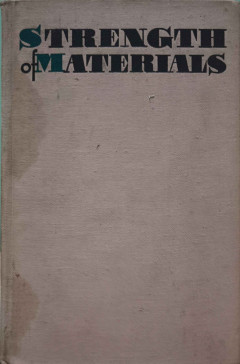
Strength of Materials
Strength of Materials is a foundational textbook in mechanics that explores the relationship between external loads applied to a stationary body and the resulting internal forces and deformations. The book provides a comprehensive study of stress and strain analysis in various structural members, including beams, shafts, and columns. It covers essential topics such as tension, compression, shea…
- Edition
- 2nd Edition
- ISBN/ISSN
- -
- Collation
- 402 pages
- Series Title
- Engineering
- Call Number
- 1ENG142
 All Categories
  Engineering
  Social Sciences
  Computer Sciences
  Religion
  Arts and Recreation
  Natural Sciences